The kitchen
The kitchen knows before you shout it.
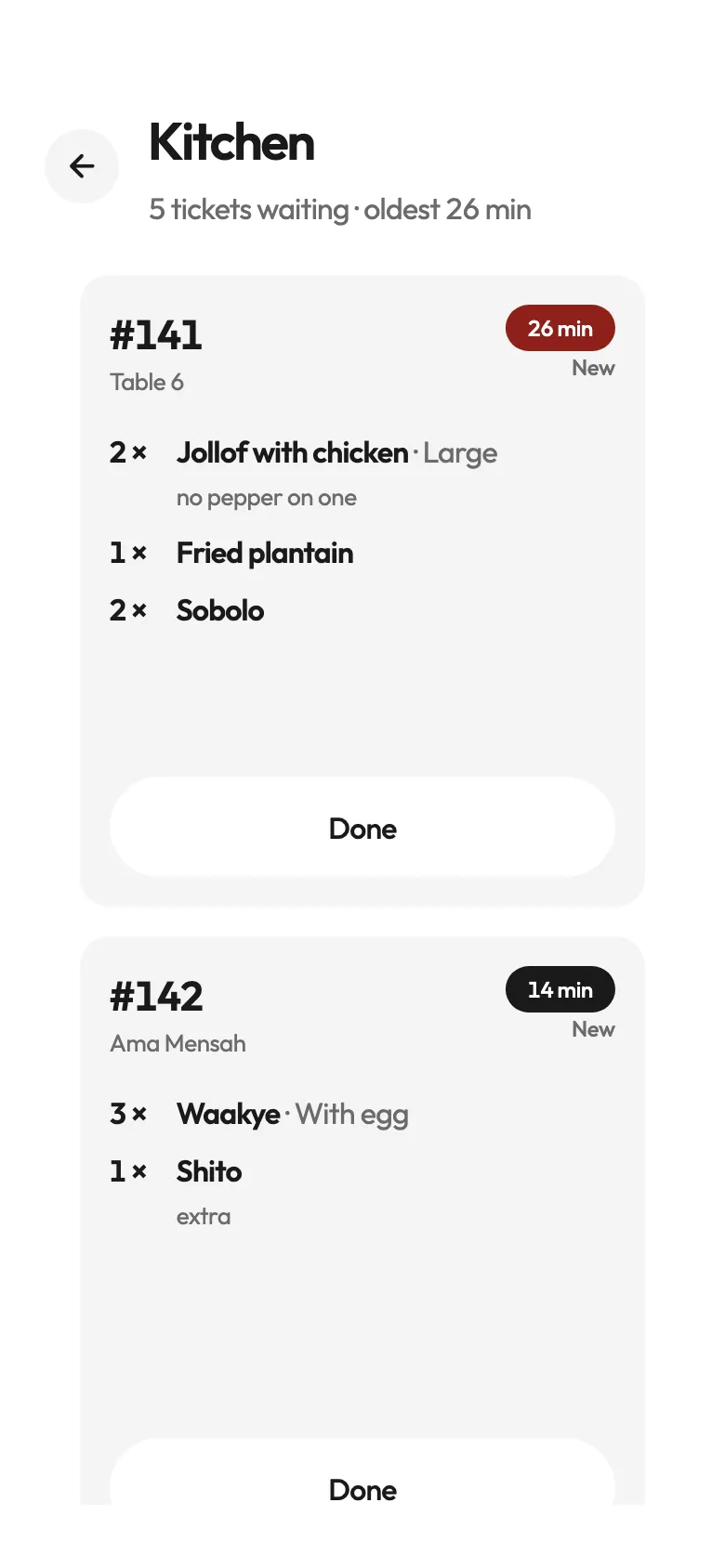
Turn any tablet into the kitchen’s screen. Every order arrives as a ticket with its number and every note on it, the oldest shows how long it’s waited, and the cook taps Done when it’s out.
The shouting stops
In most kitchens the order travels by voice. Somebody calls it through the hatch, somebody else half hears it, and the extra shito for table four gets lost somewhere between the counter and the pot. When it’s busy, the kitchen is cooking from memory.
A tablet becomes the kitchen screen
Any tablet can be set, on the tablet itself, as the kitchen’s screen. It shows the kitchen board and nothing else: no prices, no takings, no till. It’s on every plan.
You tick which categories the kitchen makes. Plates, soups and grills go to the kitchen. Drinks and the pastries from the counter don’t.
Every order, as a ticket
The moment an order leaves the till, it arrives on the board as a ticket:
- the order number, counted per day, so the counter and the kitchen talk about number 141, not “the jollof for the man in the blue shirt”;
- the tab’s name, or where it’s going: takeaway, delivery, or Bolt Food, Glovo and Chowdeck by name;
- every line with how it’s served, like Large or With egg, and any note: “no pepper on one”, “extra shito”.
The top of the board says how many are waiting and how long the oldest has been there. A ticket that’s waited too long turns red, and you choose what too long means, from five minutes to an hour.
Rounds, changes and voids
When a table orders again, the new round arrives as its own ticket, marked 2nd round. If something is taken off the bill after it was sent, the ticket shows it crossed out, so nobody finishes cooking it. If a whole sale is voided, the kitchen sees that too.
Start, Done, and back to the counter
A cook can tap Start when they pick a ticket up, and Done when it’s out. What the kitchen has just made shows along the top of the till, so whoever’s serving knows number 141 is ready without walking to the hatch.
When the kitchen hears about it
You choose when a ticket goes to the kitchen:
- When the order is put down: the moment it leaves the till, paid, set aside as a tab, or moved. Right for a sit-down place where people pay at the end.
- When it’s paid: only once the money’s taken, so the cashier’s charge is the go-ahead. Right for a takeaway where people pay first.
What it doesn’t do yet
It doesn’t print tickets, and there’s one kitchen board, not a separate screen for the grill and the drinks bar. It doesn’t take orders from a website or a QR code. And the tickets don’t time each dish for your reports yet.
What people ask
Do I need a kitchen printer?
No. A tablet in the kitchen becomes the kitchen’s screen, and the orders appear on it as tickets. There’s nothing to print.
Does everything go to the kitchen?
Only the categories you tick. Plates and soups can go to the kitchen while drinks stay at the counter.
When does the kitchen see an order?
You choose: the moment the order is put down, even as a tab, or only once it’s paid, which suits a takeaway where people pay first.
What happens when the second round comes?
It arrives as its own ticket, marked 2nd round, so the kitchen never has to look back at what it already made.
Read next
- Who it’s forRestaurantsA restaurant POS system for Ghana on the phones and tablets you have: a tab for every table, orders sent to a kitchen screen, and MoMo that’s confirmed.
- Who it’s forTakeawaysFor a fast food business in Ghana: ring up the queue fast, send orders to the kitchen when they’re paid, and keep Bolt Food, Glovo and Chowdeck apart.
- GuideBolt Food, Glovo and ChowdeckHow to keep delivery app orders straight: the apps’ money kept out of your drawer, the kitchen told where each order is going, every payout checked.
Early access
Want it on your counter?
We’re opening Tabworthy to a first circle of food and drink businesses in Ghana, a few at a time. Ten short questions, about three minutes.