Customers and credit
“I’ll pay you Friday.” The number’s still there.
Put it on their tab. Their name, their number and exactly what they owe, in one place. When Friday comes, the number’s still there, and nobody has to argue about how many plates it was.
The exercise book at the back of the counter
Every food business has one. Names down the side, amounts scribbled next to them, some crossed out, some crossed out twice. Only one person can read it. When a regular says they paid last week, there’s no way to say they didn’t, so you lose the money or you lose the customer.
Credit is how a lot of businesses in Ghana keep their regulars. The problem was never giving it. It’s keeping the number straight.
A book with everyone in it
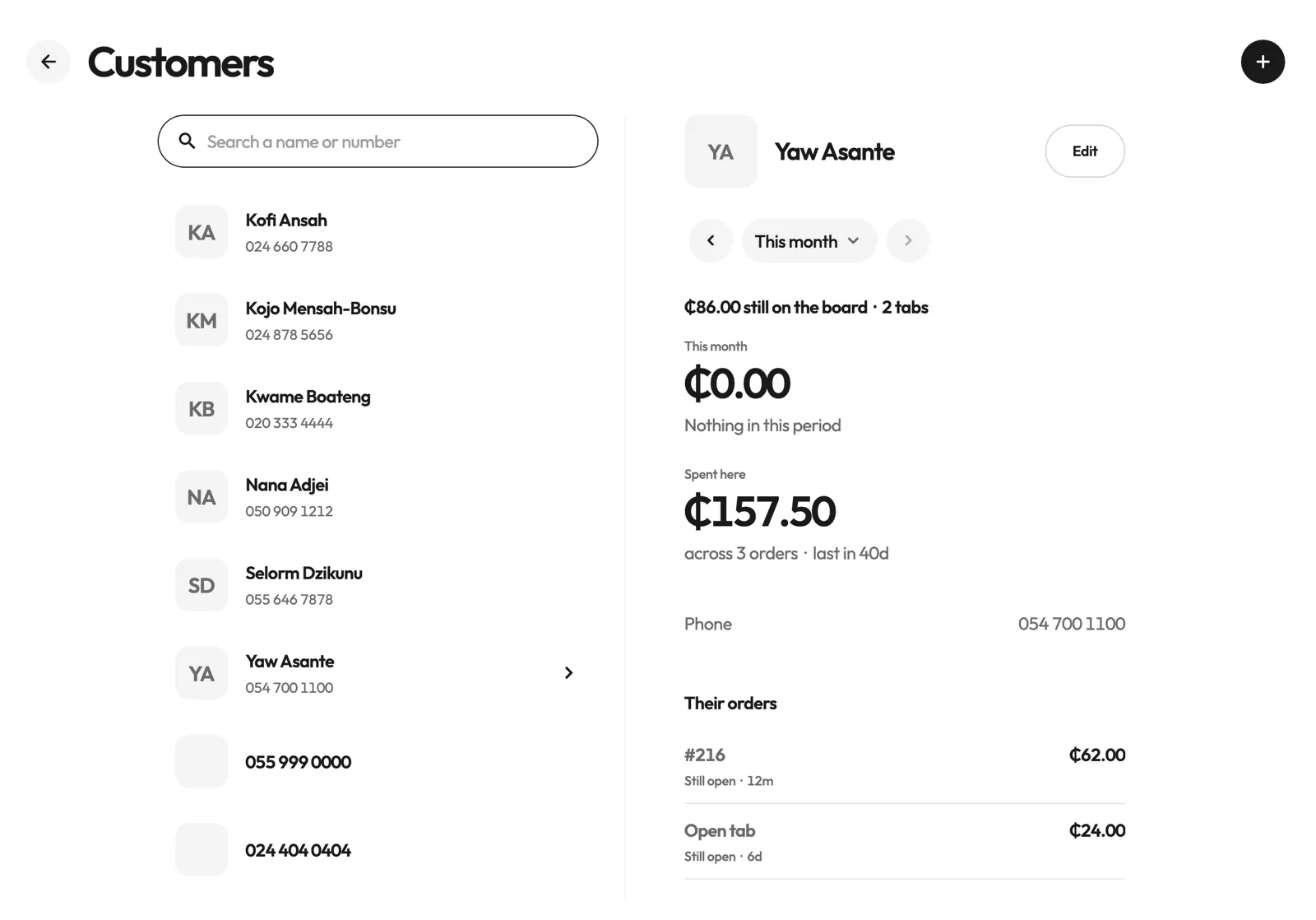
The customer book is on every plan. Each regular goes in once, with their name and number, and a note if there’s one thing worth remembering about them. From then on their page shows what they owe right now, what they’ve spent and when they were last in.
The book comes first on their page for a reason: what they owe is the thing you open it for.
Put it on their tab
When a regular takes something on credit, add them to the sale and set it aside instead of taking the money. The sale stays open under their name, with every item at the price it was rung at that day. Their page adds up everything they have open: on the screen above, ₵86.00 across two tabs.
It works the same for the office that runs a bill all month, the mechanic across the road who pays on Friday, and the seller who takes bread in the morning and settles in the evening.
When they pay
Pick up the tab and take the money like any other sale: cash with the change worked out, or MoMo as a prompt on their phone. It comes off what they owe straight away, and the receipt is a picture you can send to their WhatsApp, so there’s a record on their side too.
Because every item on the tab was rung up when it was taken, there’s nothing to reconstruct. “It was only three plates” is answered by the tab, not by anybody’s memory.
Rewards for the ones who keep coming
On Pro, you can give something back to regulars. Pick one thing you sell, how many visits earn it, and if you like, how much a visit has to come to. The till works out each regular’s visits from their sales, one visit per trading day, and tells you “3 more for a free one”. When they’ve earned it, it goes on the bill at nothing, so the sale still shows what was handed over. No points and no cards.
Seeing it across the business
The report shows what’s still open at the end of the day, tabs and credit together, so the money you’re owed never quietly drops out of the picture. If you give credit a lot, selling on credit is our guide to doing it without losing money or friends.
What it doesn’t do yet
It doesn’t send reminders by SMS or WhatsApp, and it doesn’t add interest or late fees. It doesn’t take part of a tab now and leave the rest for later. And rewards are one free thing after a number of visits, not points, tiers or cashback.
What people ask
Is there an app to keep track of customers who owe me?
Tabworthy keeps a customer book on every plan. Each regular has their name and number, what they owe right now across their open tabs, what they’ve spent and when they were last in.
How do I put a sale on credit?
Add the customer to the sale and set it aside instead of taking the money. It stays open under their name, and the book shows it as owed until they pay.
How do they pay it off?
Pick up their tab and take the money like any other sale, cash or MoMo. It comes off what they owe at once.
Can it remind them to pay?
Not yet. It doesn’t send messages. It keeps the figure right so the conversation is short.
Read next
- GuideSelling on creditWho to give credit, how much, how to write it down so there’s no argument, and how to ask for it back without losing the customer. For food businesses.
- What it doesThe reportToday’s takings since opening: cash against MoMo, what’s still open, what sold and who sold it. Read it on your own phone from anywhere. On every plan.
- Who it’s forChop barsRing up every plate in the lunch rush, take cash and MoMo in one drawer, keep regulars’ credit straight and know what the pot made. On the phone you have.
Early access
Want it on your counter?
We’re opening Tabworthy to a first circle of food and drink businesses in Ghana, a few at a time. Ten short questions, about three minutes.