Closing up
Close up without the wahala.
Count the drawer and type the number. Tabworthy already knows what should be in it, so if something’s short, you find out tonight while everyone still remembers the day.
The count that nobody trusts
Most businesses count the money at night. The trouble is what they count it against. A notebook with half the sales in it, a figure somebody remembers, or nothing at all: “it feels a bit light today”. By the time anybody’s sure it’s short, it’s next week, and nobody can remember what happened on Tuesday.
A count only means something if you know what should be there. That’s the one number a till can give you that a notebook can’t.
Open with a float
A shift starts with a float: the change you put in the drawer so the first customer with a ₵50 note doesn’t empty it. Type it in when you open the drawer. From then on every cash sale rung up during the shift is added to it, and every cash refund taken off.
MoMo, the card machine and a Bolt Food order paid on the app never go in the drawer, so they’re never counted there. The drawer is cash, and only cash.
Money that leaves for a reason
Not every cedi that leaves the drawer is a sale going wrong. The gas man is paid from the till, somebody runs to the market for tomatoes, a staff member gets an advance. Before, those went on a scrap of paper, or nowhere, and at closing the drawer just read short.
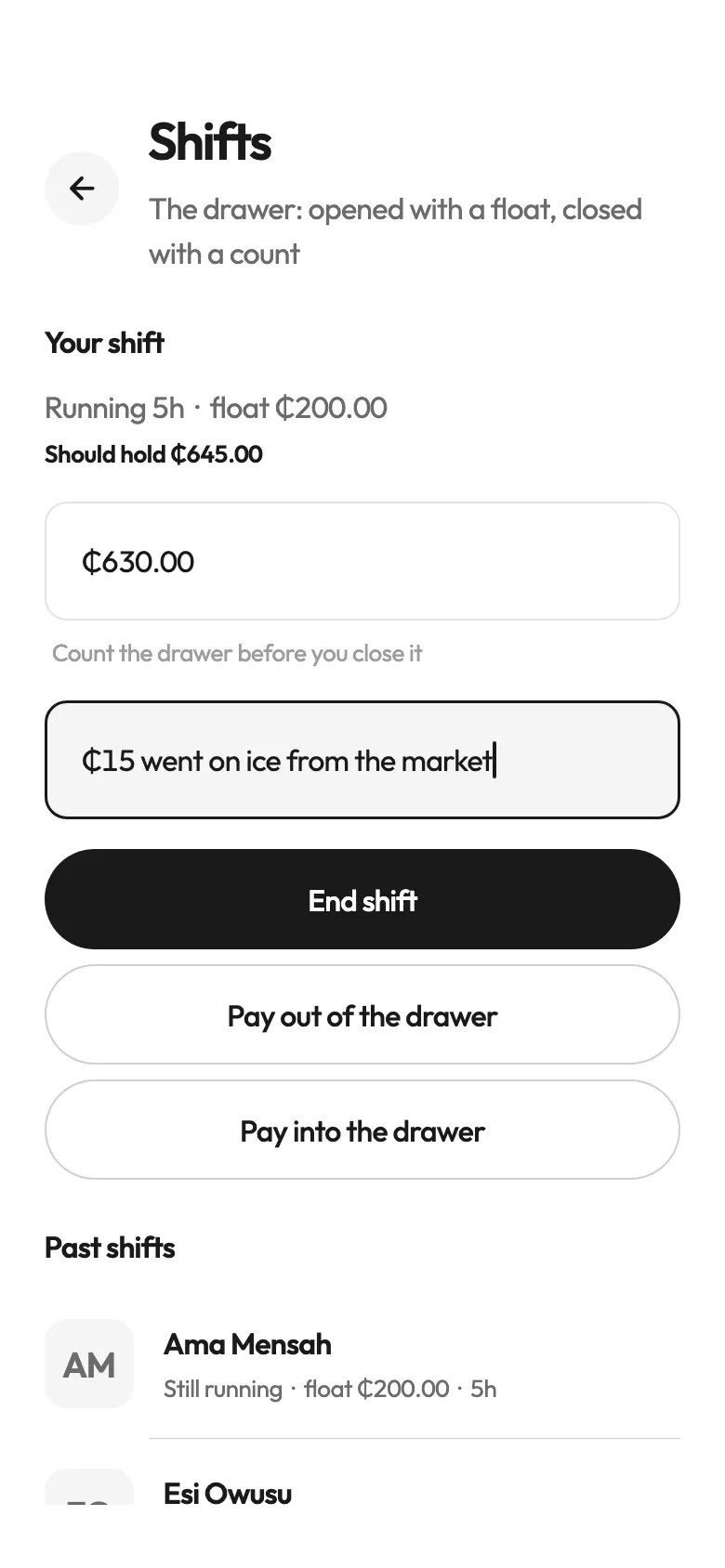
Pay out of the drawer takes the amount and what it was for, in the same breath, while the answer is still in the room. The drawer is then expected to be short by exactly that. Pay into the drawer is the other way: the float topped up, change brought back from the market, or a figure you typed wrong put right.
Close with a count
At closing, count what’s in the drawer and type the one figure. The till already knows what should be there, so it tells you at once: right on, short by ₵20, or over by ₵5. On the screen above, the drawer should hold ₵645.00; whatever you type is set against that.
It’s said against the name of whoever had the drawer. Not as an accusation, just as the number, while the person is still standing there and the day is still fresh. Most shortages have a boring explanation, and the boring explanation is easiest to find on the same night: change given wrong in a rush, a sale rung up twice, a MoMo payment taken as cash.
Short or over, by person
On Pro, where everyone signs in with their own PIN, each person’s shifts are counted on their own drawer. Over a few weeks you can see whether one drawer is always ₵20 short or it moves around. That’s a very different conversation from “money’s missing”.
The MoMo side
The drawer is half of the day. The other half is the MoMo, and it’s checked a different way: the report shows the day’s MoMo sales, and the Payouts screen shows what actually landed and which sales it covered. If a customer paid by prompt, the money was confirmed before the sale closed, so there’s nothing to chase.
If you still count note by note
Some owners like to count every denomination onto paper. Counting the drawer has a sheet that adds it up for you, note by note, and prints.
What it doesn’t do yet
It doesn’t count the notes for you; you count, it compares. It doesn’t clock anybody in or out or add up their hours. It doesn’t count the MoMo wallet for you; it tells you what should have landed. And shifts are on Pro and Chain, not the Free plan.
What people ask
How does it know what should be in the drawer?
It starts from the float you opened the shift with, adds every cash sale rung up during the shift, and allows for any money you paid out of the drawer or into it. MoMo, card-machine and delivery-app money never goes in the drawer, so it isn’t counted there.
What if I pay a supplier from the till?
Pay it out of the drawer in the app, with what it was for. The drawer is then expected to be short by exactly that, so it doesn’t read as missing money at closing.
What happens if the drawer is short?
You see it when you close the shift, against the name of whoever had the drawer. Nothing is locked or taken from anybody; you get the figure while the day is still fresh.
Do I have to count every note?
You type the total you counted. If you like counting note by note, our cash count sheet adds it up for you.
Is it on the Free plan?
Shifts and the drawer are on Pro and Chain. On the Free plan the day’s report still shows your cash sales against your MoMo.
Read next
- GuideCounting the drawerHow to count the drawer in five minutes: the float, the notes, what should be there and what to do when it’s short. With a cash count sheet that adds up.
- What it doesStaff and PINsEveryone behind the counter signs in with their own PIN and every sale remembers who rang it up, so a short drawer has an answer, not a suspect.
- What it doesThe reportToday’s takings since opening: cash against MoMo, what’s still open, what sold and who sold it. Read it on your own phone from anywhere. On every plan.
Early access
Want it on your counter?
We’re opening Tabworthy to a first circle of food and drink businesses in Ghana, a few at a time. Ten short questions, about three minutes.